

Bong Joon Ho delivers this chilling masterpiece with precision and power.
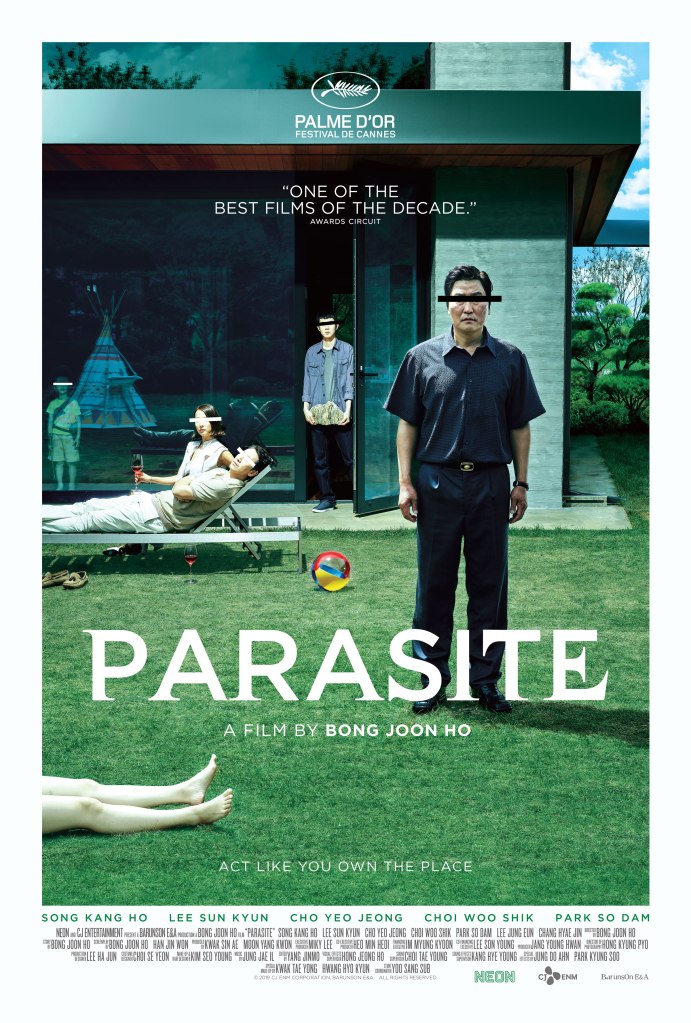
Parasite follows the Kims, a Korean working class family of four who barely get by even when collectively pitching in from their low-wage jobs. When a family friend brings them a rock that’s supposed to help bring luck, prosperity and greatly enhance the family’s riches; the story starts to form.
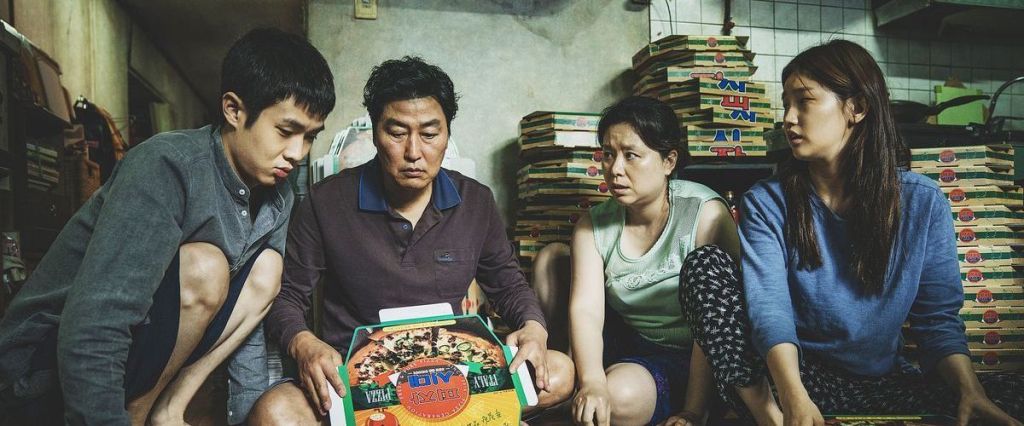
They manage to trick their way into getting hired one by one as staff for a rich family, the Parks. First the son, Ki-woo, gets hired as an English tutor and sees the opportunity to con his wealthy bosses into hiring the rest of his family. His sister, Ki-Jeong, becomes an art therapist for the rich couple’s son. His father, Ki-Taek, becomes their chauffeur and his mother, Chung-sook, becomes the cook and house staff.
There are several things worth noting about this film: its power, tragedy and subtlety. And in this review we’ll look at those through an analysis of meaning and a breakdown of tone.
METAPHOR FOR CLASS DYNAMICS
This sketch, although humorous, is an insightful look at the issues with the social class system. Though this about the UK, it captures the societal mentality when regarding social classes, income gaps and cultures within a country. It is therefore transposable to South Korea, which has a similarly strict delineations of class.

“Money irons everything out” – Chung-sook
SPOILERS!!!!!!!!
In Parasite, the rich family for the most part is not nefariously looking down at the lower class like in the sketch above, rather they are oblivious to the lower class’ struggles, which, in part, contributes to inequality. The exception perhaps is the father, Mr. Park, who notices when Ki-Taek uses vulgar language when another car cuts him off, and gives him a disapproving look. But, the Parks ignorance towards their privilege doesn’t mean they aren’t profiting off of other people.
The mom, Yeon-kyo, is so unaware of her surroundings that she doesn’t even notice the man living in hiding in the basement. The man underground, meanwhile, has no access to the outdoors, lives off of discarded food from the Parks and turns on the lights every night upon Mr. Park’s return from work, so that he feels comfortable. This exemplifies the Parks’ ignorance towards little expected comforts, which are the result of someone’s else work.

Parasite offers up some pretty grim messages too:
- if you’re poor, then you’ll inevitably have a hard life
- and, money doesn’t equal happiness
This first message intimates a sort of predestined life dictated by class. For no matter how hard the Kims try, troubles always seem to come knocking at their door. The epitome of this is captured in the oddly fascinating scene where Ki-Jeong smokes a cigarette while the toilet erupts a grimy black substance and slowly floods the entire bathroom. Hauntingly beautiful.
Since the theme of destiny governed by class is present throughout the whole movie, it makes sense that the family’s attempts to get out of their class would have tragic repercussions. It’s almost like a Greek tragedy in that way. Fighting, like Atlas, against an immovable reality. Ki-Jeong, got killed then not because of a random act of violence but because the Kims allegorically played with fate by conning their way into being rich.
By doing this, Bong Joon Ho shows the difficulty, the near impossibility of change or progress in a society that still separates people based off of their wealth, vernacular or by the color of their skin. This is an urgent and powerful message for Korea but equally for countries that operate like this, too (read: many, if not all countries’ systems).

The second message is that material wealth is not necessarily the most valuable kind of wealth. By the end of the movie, the Kims accumulated money in their bank accounts, but they lost someone who was a lot more valuable to them. They lost Ki-Jeong. And, Ki-Taek now has to live in hiding and he has lost his freedom. Ultimately, family and freedom were the most important aspects to the Kim family unit. Even though they got a taste of riches, it wasn’t worth the trade in for a dead daughter/sister and a father/husband who is in hiding.
TONE
Essentially, Parasite worked as a dark comedy for the first half, even producing laughs along the way. I even thought to myself: “is this the dark film everybody been’s talking to me about?”. What I didn’t realize was that is that the story was gaining momentum before becoming dark.
The tonal center was gradually building out of a dark comedy and shifting slowly into a frenzied, harrowing thriller. This wasn’t so much of a sudden change but a gradual progression which speaks to Bong Joon Ho’s mastery of tone and subtle storytelling.
With an unforgettable mindfuck of a crescendo at the party scene.

Parasite is a wild, politically engaged, and beautifully executed movie – ⭐⭐⭐⭐⭐

